In this ever fast moving world, somethings or some events are just too hard to be explained by its unknown causes, here you will find some of the bizzare cases which are unsolved.
The Voynich manuscript is an illustrated codex hand-written in an unknown writing system. The vellum in the book pages has been carbon-dated to the early 15th century (1404–1438), and may have been composed in Northern Italy during the Italian Renaissance. The manuscript is named after Wilfrid Voynich, a Polish book dealer who purchased it in 1912.The pages of the codex are vellum. Some of the pages are missing, but about 240 remain. The text is written from left to right, and most of the pages have illustrations or diagrams.The Voynich manuscript has been studied by many professional and amateur cryptographers, including American and British codebreakers from both World War I and World War II. No one has yet succeeded in deciphering the text, and it has become a famous case in the history of cryptography. The mystery of the meaning and origin of the manuscript has excited the popular imagination, making the manuscript the subject of novels and speculation. None of the many hypotheses proposed over the last hundred years has yet been independently verified. Many people have speculated that the writing might be nonsense.
The Voynich manuscript was donated by Hans P. Kraus to Yale University's Beinecke Rare Book and Manuscript Library in 1969, where it is catalogued under call number MS 408. A digitized high-resolution copy is also accessible freely at their website.The text was clearly written from left to right, with a slightly ragged right margin. Longer sections are broken into paragraphs, sometimes with star- or flower-like "bullets" in the left margin. There is no obvious punctuation, and no indications of any errors or corrections made at any place in the document. The ductus flows smoothly, giving the impression that the symbols were not enciphered, as there is no delay between characters as would normally be expected in written encoded text.
The text consists of over 170,000 glyphs, usually separated from each other by narrow gaps. Most of the glyphs are written with one or two simple pen strokes. While there is some dispute as to whether certain glyphs are distinct or not, an alphabet with 20–30 glyphs would account for virtually all of the text; the exceptions are a few dozen rarer characters that occur only once or twice each. Various transcription alphabets have been created, to equate the Voynich glyphs with Latin characters in order to help with cryptanalysis, such as the European Voynich Alphabet. The first major one was created by cryptographer William F. Friedman in the 1940s, where each line of the manuscript was transcribed to an IBM punch card to make it machine-readable.
Wider gaps divide the text into about 35,000 "words" of varying length. These seem to follow phonological or orthographic laws of some sort, e.g., certain characters must appear in each word (like English vowels), some characters never follow others, some may be doubled or tripled but others may not, etc.Statistical analysis of the text reveals patterns similar to those of natural languages. For instance, the word entropy (about 10 bits per word) is similar to that of English or Latin texts. Some words occur only in certain sections, or in only a few pages; others occur throughout the manuscript. There are very few repetitions among the thousand or so "labels" attached to the illustrations.
On the other hand, the Voynich manuscript's "language" is quite unlike European languages in several aspects. There are practically no words with fewer than two letters or more than ten. The distribution of letters within words is also rather peculiar: some characters occur only at the beginning of a word, some only at the end, and some always in the middle section. While Semitic alphabets have many letters that are written differently depending on whether they occur at the beginning, in the middle or at the end of a word, letters of the Latin, Cyrillic, and Greek alphabets are generally written the same way regardless of their position within a word (with the Greek letter sigma and the obsolete long s being notable exceptions).The text seems to be more repetitive than typical European languages; there are instances where the same common word appears up to three times in a row.[13] Words that differ by only one letter also repeat with unusual frequency, causing single-substitution alphabet decipherings to yield babble-like text. Elizebeth Friedman in 1962 described such attempts as "doomed to utter frustration".
There are only a few words in the manuscript written in a seemingly Latin script. On the last page, there are four lines of writing written in rather distorted Latin letters, except for two words in the main script. The lettering resembles European alphabets of the late 14th and 15th centuries, but the words do not seem to make sense in any language. Also, a series of diagrams in the "astronomical" section has the names of ten of the months (from March to December) written in Latin script, with spelling suggestive of the medieval languages of France, northwest Italy or the Iberian Peninsula. However, it is not known whether these bits of Latin script were part of the original text or were added later.
Sailing stones, sliding rocks, and moving rocks all refer to a geological phenomenon where rocks move and inscribe long tracks along a smooth valley floor without human or animal intervention. Tracks from these sliding rocks have been observed and studied in various locations, including Little Bonnie Claire Playa in Nevada, and most notably Racetrack Playa, Death Valley National Park, California, where the number and length of tracks are notable. At Racetrack Playa, these tracks have been studied since the early 1900s, yet the origins of stone movement are not confirmed and remain the subject of research for which several hypotheses exist.
The stones move only every two or three years and most tracks develop over three or four years. Stones with rough bottoms leave straight striated tracks while those with smooth bottoms tend to wander. Stones sometimes turn over, exposing another edge to the ground and leaving a different track in the stone's wake.
Trails differ in both direction and length. Rocks that start next to each other may travel parallel for a time, before one abruptly changes direction to the left, right, or even back to the direction from which it came. Trail length also varies – two similarly sized and shaped rocks may travel uniformly, then one could move ahead or stop in its track.
The first documented account of the sliding rock phenomenon dates to 1915, when a prospector named Joseph Crook from Fallon, Nevada visited the Racetrack Playa site. In the following years, the Racetrack sparked interest from geologists Jim McAllister and Allen Agnew, who mapped the bedrock of the area in 1948 and published the earliest report about the sliding rocks in a Geologic Society of America Bulletin. Their publication gave a brief description of the playa furrows and scrapers, stating that no exact measurements had been taken and suggesting that furrows were the remnants of scrapers propelled by strong gusts of wind – such as the variable winds that produce dust-devils – over a muddy playa floor.Controversy over the origin of the furrows prompted the search for the occurrence of similar phenomena at other locations. Such a location was found at Little Bonnie Claire Playa in Nye County, Nevada, and the phenomenon was studied there as well.
Naturalists from the National Park Service later wrote more detailed descriptions and Life magazine featured a set of photographs from the Racetrack. In 1952, a National Park Service Ranger named Louis G. Kirk recorded detailed observations of furrow length, width, and general course. He sought simply to investigate and record evidence of the moving rock phenomenon, not to hypothesize or create an extensive scientific report. Speculation about how the stones move started at this time. Various and sometimes idiosyncratic possible explanations have been put forward over the years that have ranged from the supernatural to the very complex. Most hypotheses favored by interested geologists posit that strong winds when the mud is wet are at least in part responsible. Some stones weigh as much as a human, which some researchers, such as geologist George M. Stanley, who published a paper on the topic in 1955, feel is too heavy for the area's wind to move. After extensive track mapping and research on rotation of the tracks in relation to ice floe rotation, Stanley maintained that ice sheets around the stones either help to catch the wind or that ice floes initiate rock movement.
Progress in the 1970s
Bob Sharp and Dwight Carey started a Racetrack stone movement monitoring program in May 1972. Eventually thirty stones with fresh tracks were labeled and stakes were used to mark their locations. Each stone was given a name and changes in the stones' position were recorded over a seven-year period. Sharp and Carey also tested the ice floe hypothesis by corralling selected stones. A corral 5.5 feet (1.7 m) in diameter was made around a 3 inches (7.6 cm) wide, 1 pound (0.45 kg) track-making stone with seven rebar segments placed 25 to 30 inches (64 to 76 cm) apart. If a sheet of ice around the stones either increased wind-catching surface area or helped move the stones by dragging them along in ice floes, then the rebar should at least slow down and deflect the movement. Neither appeared to occur; the stone barely missed a rebar as it moved 28 feet (8.5 m) to the northwest out of the corral in the first winter. Two heavier stones were placed in the corral at the same time; one moved five years later in the same direction as the first but its companion did not move during the study period. This indicated that if ice played a part in stone movement, then ice collars around stones must be small.
A panorama of the Milky Way with the tracks of sailing stones below. Notice the stone on the right side.
Ten of the initial twenty-five stones moved in the first winter with Mary Ann (stone A) covering the longest distance at 212 feet (65 m). Two of the next six monitored winters also saw multiple stones move. No stones were confirmed to have moved in the summer and some winters none or only a few stones moved. In the end all but two of the thirty monitored stones moved during the seven-year study. At 2.5 inches (6.4 cm) in diameter, Nancy (stone H) was the smallest monitored stone. It also moved the longest cumulative distance, 860 feet (260 m), and the greatest single winter movement, 659 feet (201 m). The largest stone to move was 80 pounds (36 kg).
Karen (stone J) is a 29 by 19 by 20 inches (74 by 48 by 51 cm) block of dolomite and weighs an estimated 700 pounds (318 kg). Karen did not move during the monitoring period. The stone may have created its 570 feet (170 m) long straight and old track from momentum gained from its initial fall onto the wet playa. However, Karen disappeared sometime before May 1994, possibly during the unusually wet winter of 1992 to 1993. Removal by artificial means is considered unlikely due to the lack of associated damage to the playa that a truck and winch would have caused. A possible sighting of Karen was made in 1994 a half mile (800 m) from the playa. Karen was rediscovered by San Jose geologist Paula Messina in 1996.
Twinkle Dwivedi was only eleven years old when she first exhibited the strange condition that gained her worldwide attention. There, in the midst of her friends, she began to cry blood. Although she claimed it didn't hurt, she was ridiculed by her peers and became an object of both disgust, wonder, and mystery.
Blood not only oozes from Twinkle's tear ducts up to fourteen times a day, but also from her pores as well.
Even now, as she has grown, there has been no medical explanation for her condition. Some religious and supernatural explanations have been offered, but no one seems to be able to agree. It could even be that Twinkle suffers from a disease so rare that she is the only person on record to have been afflicted by it. It could also be that there is some sort of deception for fame or money involved.
Whatever the case, Twinkle continues to be a source of wonder and sympathy for those around her.
At the dawn of the Space Race, the United States and Soviet Union were in a neck in neck sprint to claim the heavens for their own glorious empires, but as mission after mission wrenched the secrets of the universe from the stars above, rumors began to circulate that some of the explorers that were rocketed into the skies above, never returned.These people have become known as the Lost Cosmonauts.The theory of the lost cosmonauts begins, strangely enough, in Italy with a pair of brothers named Achille and Giovanni Judica-Cordiglia. The brothers were amateur radio operators and had already become well-known for picking up transmissions from Sputnik and even the heartbeats of the Soviet space dog, Laika, on board Sputnik II (Laika herself is a lost cosmonaut).
On November 28, 1960, the brothers were alerted to something strange. An East German observatory announced that they had picked up a strange signal on the Soviet space frequencies. When the Cordiglias tuned into that frequency, they picked up what sounded like a hand-keyed SOS signal. The most disturbing thing about the signal is that it showed almost no relative speed which could only mean one thing: it was on a direct course away from the planet. As the brothers listened, the signal grew weaker until it finally winked out.
The brothers had apparently just discovered evidence that a Soviet space capsule had gone off course and drifted permanently into outer space with a cosmonaut on board.Two months later, the brothers detected another transmission. This time, it seemed to be the labored breaths of an unconscious man and a heartbeat. When they played the recording for their father, a cardiologist, he postulated that the heartbeat was of a man suffering cardiac arrest.
Two days later, the Soviets announced the failed re-entry of a large unmanned spacecraft.
In April of 1961, the brothers picked up the transmissions of Yuri Gargarin, the official first person to orbit the Earth.The story wasn't over. In fact, the most disturbing chapter was still to come. In May of 1961, they picked up a new transmission. It was a a woman's voice speaking in Russian. Although she seemed calm and professional, her tone became more and more strained an panicked as the transmission continued and finally ceases.The translation came out as, "Isn't this dangerous? Talk to me! Our transmission begins now. I feel hot. I can see a flame. Am I going to crash? Yes. I feel hot, I will re-enter..."
Cold War Russia was a torrent of secrets. It is well documented that there were cosmonaut deaths prior to Gargarin's flight and it is also well known that Grigoriy Nelyubov, a cosmonaut who committed suicide in 1966 after being bounced from the program, was effectively erased from the records - airbrushed from photographs, his medical and service records edited. In fact, Nelyubov's involvement in the program wasn't brought to light until 1986.It's thought by proponents of the lost cosmonaut theory that the USSR lost as many as eleven people.Still, the Soviet Union never acknowledged that they had lost any cosmonauts in space. Many have said that the Soviets covered up the deaths to prevent any damage to the reputation of their space program while others have said that the Cordiglia brothers manufactured their recordings.
With the almost irrational secrecy of the Soviet Empire, it is not hard to imagine covering up something that might lead to national embarrassment in the face of competition with their greatest rivals, and if these lost cosmonauts did exist, official information on them has either been long-since lost or are still gathering dust somewhere.If they did exist, however, the most incontrovertible evidence floats somewhere out there in the infinite void, a cold and powerless metal tomb with a forgotten hero waiting patiently for the day he might be found by the explorers of a later age.
The Shroud of Turin or Turin Shroud (Italian: Sindone di Torino) is a length of linen cloth bearing the image of a man who appears to have suffered physical trauma in a manner consistent with crucifixion. There is no consensus yet on exactly how the image was created, and it is believed by some to be the burial shroud of Jesus of Nazareth, despite radiocarbon dating placing its origins in the Medieval period. The image is much clearer in black-and-white negative than in its natural sepia color. The negative image was first observed in 1898, on the reverse photographic plate of amateur photographer Secondo Pia, who was allowed to photograph it while it was being exhibited in the Turin Cathedral. The shroud is kept in the royal chapel of the Cathedral of Saint John the Baptist in Turin, northern Italy.
The origins of the shroud and its image are the subject of intense debate among theologians, historians and researchers. Scientific and popular publications have presented diverse arguments for both authenticity and possible methods of forgery. A variety of scientific theories regarding the shroud have since been proposed, based on disciplines ranging from chemistry to biology and medical forensics to optical image analysis. The Catholic Church has neither formally endorsed nor rejected the shroud, but in 1958 Pope Pius XII approved of the image in association with the devotion to the Holy Face of Jesus. More recently, Pope Francis and his predecessor Pope Benedict XVI have both described the Shroud of Turin as “an icon”.
In 1978, a detailed examination carried out by a team of American scientists, called the Shroud of Turin Research Project (STURP), found no reliable evidence of how the image was produced. In 1988 a radiocarbon dating test was performed on small samples of the shroud. The laboratories at the University of Oxford, the University of Arizona, and the Swiss Federal Institute of Technology concurred that the samples they tested dated from the Middle Ages, between 1260 and 1390. The validity and the interpretation of the 1988 tests are still contested by some statisticians, chemists and historians.According to professor Christopher Ramsey of the Oxford Radiocarbon Accelerator Unit in 2011, "There are various hypotheses as to why the dates might not be correct, but none of them stack up."
According to former Nature editor Philip Ball, "it's fair to say that, despite the seemingly definitive tests in 1988, the status of the Shroud of Turin is murkier than ever. Not least, the nature of the image and how it was fixed on the cloth remain deeply puzzling". The shroud continues to remain one of the most studied and controversial objects in human history
Winenchester Mystery House™ is an extravagant maze of Victorian craftsmanship – marvelous, baffling, and eerily eccentric, to say the least. Tour guides must warn people not to stray from the group or they could be lost for hours! Countless questions come to mind as you wander through the mansion – such as, what was Mrs. Winchester thinking when she had a staircase built that descends seven steps and then rises eleven?
Some of the architectural oddities may have practical explanations. For example, the Switchback Staircase, which has seven flights with forty four steps, rises only about nine feet, since each step is just two inches high. Mrs. Winchester's arthritis was quite severe in her later years, and the stairway may have been designed to accommodate her disability.The miles of twisting hallways are made even more intriguing by secret passageways in the walls. Mrs. Winchester traveled through her house in a roundabout fashion, supposedly to confuse any mischievous ghosts that might be following her.
This wild and fanciful description of Mrs. Winchester’s nightly prowl to the Séance Room appeared in The American Weekly in 1928, six years after her death:“When Mrs. Winchester set out for her Séance Room, it might well have discouraged the ghost of the Indian or even of a bloodhound, to follow her. After traversing an interminable labyrinth of rooms and hallways, suddenly she would push a button, a panel would fly back and she would step quickly from one apartment into another, and unless the pursuing ghost was watchful and quick, he would lose her. Then she opened a window in that apartment and climbed out, not into the open air, but onto the top of a flight of steps that took her down one story only to meet another flight that brought her right back up to the same level again, all inside the house. This was supposed to be very discomforting to evil spirits who are said to be naturally suspicious of traps.”
Winchester’s Building Methods
According to legend, Mrs. Winchester enacted a nightly séance to help with her building plans and for protection from “bad” spirits. While she sometimes drew up simple sketches of the building ideas, there were never any blueprints….or building inspectors! In the morning, she would meet with John Hansen, her dutiful foreman, and go over new changes and additions.
During the early years of construction, this resulted in some awkward and impractical concepts such as columns being installed upside down – though some suggest this was done deliberately to confuse the evil spirits.But this is how the Winchester Mystery House™ became known as “the house built by the spirits.” John Hansen stayed with Mrs. Winchester for many years, redoing scores of rooms, remodeling them one week and tearing them apart the next.
It is doubtful whether John Hansen ever questioned his boss. Mrs. Winchester may have been trying to confuse evil spirits, or simply making mistakes, but there were no budget ceilings or deadlines to meet. This resulted in many features being dismantled, built around, or sealed over. Some rooms were remodeled many times. It is estimated that 500 rooms to 600 rooms were built, but because so many were redone, only 160 remain. This naturally resulted in some peculiar effects, such as stairs that lead to the ceiling, doors that go nowhere and that open onto walls, and chimneys that stop just short of the roof!
Furnishings
Once a room was completed, and most importantly, not targeted for further alterations, it was adorned with some of the best furnishings money could buy. Mrs. Winchester appreciated beauty, and she was a woman with exquisite taste. Freight cars loaded with gold and silver plated chandeliers, imported Tiffany art glass windows then valued up to $1,500 each, German silver and bronze inlaid doors at twice that amount, Swiss molded bathtubs, rare precious woods like mahogany and rosewood, and countless other items were docked onto a side track at San Jose. Everything was then transported to the house where much of the material was never even installed. At the time of Mrs. Winchester’s death in 1922, there were rooms full of ornate treasures still waiting to find a niche in the massive home.
Parquet Floors
Among the most remarkable features of the house are the parquet floors. One craftsman worked for thirty-three years doing nothing but building, installing, and tearing up the floors! They are made of mahogany, rosewood, teak, maple, oak and white ash, arranged in impressive mosaics. Mrs. Winchester’s favorite bedroom, the one in which she died, has a notably special floor. It is laid so that the sunlight streaming through the windows appears to change the dark strips to light, and then back again, when viewed from the opposite ends of the room.
Art Glass
Though Mrs. Winchester could be very frugal in her approach to building, at times she was extravagant as a person could be. The mansion’s dazzling art glass windows are a good example of her exquisite taste. Many were made to order in Austria and imported by Tiffany’s of New York. They are spectacularly designed, utilizing both concave and convex glass “frames” inset with glittering “jewels.” Mrs. Winchester herself designed the special daisy and spiderweb patterns that are embedded in many of the window. The daisy was her favorite flower, and some believe the spiderweb pattern had a special occult meaning for her.
Cabinets
The finest cabinetmakers toiled for years, using richly polished woods, to create built-in chests with deep drawers and tremendous bins and lockers. Inside were stored the rarest satins and silks; hand-embroidered linens from China, Ireland, and the Philippines; and bolt upon bolt of elegantly woven cloth from Persia and India. Legend has it that Mrs. Winchester bought whole bolts of material so that nobody else in the valley would have the same pattern.
Hall of Fires
Because of the mansion’s immense size, it contained forty-seven fireplaces and seventeen chimneys. One rambling section in particular, the Hall of Fires, was designed to produce as much heat as possible – perhaps to ease Mrs. Winchester’s extreme arthritis. In addition to many windows that let the sunlight stream through, the three adjoining rooms have four fireplaces and three hot air registers from the coal furnace in the basement.
The Grand Ballroom
Mrs. Winchester’s elegant Grand Ballroom is built almost entirely without nails. It cost over $9,000 to complete at a time when an entire house could be built for less than $1,000! The silver chandelier is from Germany, and the walls and parquet floor are made of six hardwoods – mahogany, teak, maple, rosewood, oak, and white ash.
The most curious element of the Grand Ballroom are the two leaded stained glass windows, each inscribed with a quote from Shakespeare. The first, “Wide unclasp the table of their thoughts,” is from Troilus and Cressida (IV:5:60). The lines are spoken by Ulysses, and refer to Cressida’s sometimes flirting nature. The second, “These same thoughts people this little world,” is from Richard II (V:5:9). The imprisoned Richard means that his thoughts people the small world of his confinement. Nobody knows for certain what these lines meant to Mrs. Winchester. While they apparently held some special meaning for Mrs. Winchester, their significance remains a mystery today.
Ironically, the ballroom was probably never used to hold a ball. According to one story, Mrs. Winchester once heard that a celebrated orchestra was performing in San Francisco. She invited the musicians to play at her home, but scheduling conflicts prevented the visit. In any case, Mrs. Winchester sealed off the ballroom after the earthquake of 1906.
The 1906 Earthquake
If Mrs. Winchester took precautions to enlist the aid of friendly spirits, they were nevertheless unable to protect her from the Great San Francisco Bay Area Earthquake of 1906. The quake registered 8.3 on the Richter scale and stretched all the way from Oregon to Los Angeles. It severely damaged Mrs. Winchester’s home, toppling the seven-story Observation Tower and some cupolas. She herself was badly shaken, trapped in her favorite Daisy Bedroom near the front of the mansion. It took servants several hours to locate her and then pry open the bedroom door and rescue her.
Its is said that Mrs. Winchester felt the earthquake was a warning from the spirits that she had spent too much money on the front section of the house, which was nearing completion. After having the structural damage repaired, she immediately ordered the front thirty rooms – including the Daisy Bedroom, Grand Ballroom, and the beautiful front doors – sealed up.
The heavy, ornate front doors, which had been installed just prior to the earthquake, had only been used by three people – Mrs. Winchester and the two carpenters who installed them.
Exterior Architecture
The outside of the mansion received nearly as much care and attention as the inside. The cast external facade is bursting with Queen Anne Victorian architecture feature like turrets, towers, curved walls, cupolas, cornices, and balconies, all outlined with finely detailed trimwork.
When viewed from different angles, the towers, some topped by ornamental spires called finials, give the house a castlelike appearance.
A House Built For Spirits?
We may never know for sure if Mrs. Winchester built her house to accommodate the spirits, but over the years the story has come down that she believed her life was unavoidably affected by departed souls. Presumably she wanted to be friendly with the “good” spirits and avoid the “bad” spirits – and the way to be friendly with the “good” spirit, it seemed, was to build them a nice place to visit.
According to this theory, Mrs. Winchester accommodated the friendly spirits by giving them special attention. For example, it is said that there were only three mirrors in the entire house at the time of Mrs. Winchester’s death. Legend has it that spirits hate mirrors, since the sight of their reflection causes them to vanish.
This is why Mrs. Winchester’s servants and secretary reportedly used only hand mirrors or went without.
The mansion also contained a profusion of light sources, from gas jets and countless candles, to electric light bulbs. Supposedly spirits feel conspicuous and humiliated by shadows, since they cannot cast their own.
Was Mrs. Winchester making a special effort to please her spirits companions?
In any case, for nearly thirty-eight years, the round-the-clock sawing, sanding, and hammering at the Winchester Mystery House™ never ceased – not even on weekends or holidays. It was never a rush job. Mrs. Winchester had all the time in the world – at least, all the time needed to maintain a steady pace. With her financial freedom, she was content to honor whatever whims came from her imagination and from the spirits she believed were guiding her.
The crystal skulls are human skull hardstone carvings made of clear or milky white quartz, known in art history as "rock crystal", claimed to be pre-Columbian Mesoamerican artifacts by their alleged finders; however, none of the specimens made available for scientific study have been authenticated as pre-Columbian in origin.
The results of these studies demonstrated that those examined were manufactured in the mid-19th century or later, almost certainly in Europe during a time when interest in ancient culture was abundant. Despite some claims presented in an assortment of popularizing literature, legends of crystal skulls with mystical powers do not figure in genuine Mesoamerican or other Native American mythologies and spiritual accounts.The skulls are often claimed to exhibit paranormal phenomena by some members of the New Age movement, and have often been portrayed as such in fiction. Crystal skulls have been a popular subject appearing in numerous sci-fi television series, novels, films, and video games.
Some believers in the paranormal claim that crystal skulls can produce a variety of miracles. Anna Mitchell-Hedges claimed that the skull she allegedly discovered could cause visions, cure cancer, that she once used its magical properties to kill a man, and that in another instance, she saw in it a premonition of the John F. Kennedy assassination.
In the 1931 play The Satin Slipper by Paul Claudel, King Philip II of Spain uses "a death's head made from a single piece of rock crystal," lit by "a ray of the setting sun," to see the defeat of his Armada in its attack on England.
Claims of the healing and supernatural powers of crystal skulls have no support in the scientific community, which has found no evidence of any unusual phenomena associated with the skulls nor any reason for further investigation, other than the confirmation of their provenance and method of manufacture.
Another novel and historically unfounded speculation ties in the legend of the crystal skulls with the completion of the current Maya calendar b'ak'tun-cycle on December 21, 2012, claiming the re-uniting of the thirteen mystical skulls will forestall a catastrophe allegedly predicted or implied by the ending of this calendar . An airing of this claim appeared (among an assortment of others made) in The Mystery of the Crystal Skulls, a 2008 program produced for the Sci Fi Channel in May and shown on Discovery Channel Canada in June. Interviewees included Richard Hoagland, who attempted to link the skulls and the Maya to life on Mars, and David Hatcher Childress, proponent of lost Atlantean civilizations and anti-gravity claims.
Crystal skulls are also referenced by author Drunvalo Melchizedek in his book Serpent of Light. He writes that he came across indigenous Mayan descendants in possession of crystal skulls at ceremonies at temples in the Yucatán, which he writes contained souls of ancient Mayans who had entered the skulls to await the time when their ancient knowledge would once again be required.
The alleged associations and origins of crystal skull mythology in Native American spiritual lore, as advanced by neoshamanic writers such as Jamie Sams, are similarly discounted. Instead, as Philip Jenkins notes, crystal skull mythology may be traced back to the "baroque legends" initially spread by F.A. Mitchell-Hedges, and then afterwards taken up:
By the 1970s, the crystal skulls [had] entered New Age mythology as potent relics of ancient Atlantis, and they even acquired a canonical number: there were exactly thirteen skulls.
None of this would have anything to do with North American Indian matters, if the skulls had not attracted the attention of some of the most active New Age writers. Documentary video
Spontaneous human combustion (SHC) is a term encompassing reported cases of the combustion of a living (or very recently deceased) human body without an apparent external source of ignition. In addition to reported cases, examples of SHC appear in literature, and both types have been observed to share common characteristics regarding circumstances and remains of the victim.
Forensic investigations have attempted to analyze reported instances of SHC and have resulted in hypotheses regarding potential causes and mechanisms, including victim behavior and habits, alcohol consumption and proximity to potential sources of ignition, as well as the behavior of fires that consume melted fats. Natural explanations, as well as unverified natural phenomena, have been proposed to explain reports of SHC.
Spontaneous human combustion" refers to the death from a fire originating without an apparent external source of ignition; the fire is believed to start within the body of the victim. This idea and the term 'spontaneous human combustion' were first both proposed in 1746 by Paul Rolli in an article published in the Philosophical Transactions.[1] Writing in the British Medical Journal, coroner Gavin Thurston describes the phenomenon as having "attracted the attention not only of the medical profession but of the laity" as early as 1834 (more than one hundred years prior to Thurston's 1938 article).[2] In his 1995 book Ablaze!, Larry E. Arnold wrote that there had been about 200 cited reports of spontaneous human combustion worldwide over a period of around 300 years.The topic received coverage in the British Medical Journal in 1938. An article by L. A. Parry cited an 1823-published book Medical Jurisprudence, which stated that commonalities among recorded cases of spontaneous human combustion included the following characteristics:
the recorded cases have these things in common:
the victims are chronic alcoholics;
they are usually elderly females;
the body has not burned spontaneously, but some lighted substance has come into contact with it;
the hands and feet usually fall off;
the fire has caused very little damage to combustible things in contact with the body;
the combustion of the body has left a residue of greasy and fetid ashes, very offensive in odour."
Alcoholism is a common theme in early SHC literary references, in part because some Victorian era physicians and writers believed spontaneous human combustion was the result of alcoholism
Some hypotheses attempt to explain how SHC might occur without an external flame source, while other hypotheses suggest incidents that might appear as spontaneouscombustion actually had an external source of ignition – and that the likelihood of spontaneous human combustion without an external ignition source is quite low. Benjamin Radford, science writer and deputy editor of the science magazine Skeptical Inquirer, casts doubt on the plausibility of spontaneous human combustion, "If SHC is a real phenomenon (and not the result of an elderly or infirm person being too close to a flame source), why doesn't it happen more often? There are 5 billion [The world's population reached 5 billion in 1987] people in the world, and yet we don't see reports of people bursting into flame while walking down the street, attending football games, or sipping a coffee at a local Starbucks." Paranormal researcher Brian Dunning states that SHC stories "are simply the rare cases where a natural death in isolation has been followed by a slow combustion from some nearby source of ignition." He further suggested that reports of people suddenly aflame should be called "Unsolved deaths by fire", stating that an unknown cause did not necessarily imply that the fire lacked an external ignition source.
In 1981, author and publisher Byron Preiss traveled to 12 locations in the continental U.S. (and possibly Canada) to secretly bury a dozen ceramic casques. Each casque contained a small key that, once found, could be redeemed for one of 12 birthstone jewels Preiss kept in a safe deposit box in New York.
The Secret: A Treasure Hunt was published in America in 1982. It contained 12 paintings and 12 verses. The key to finding the casques Preiss had buried and subsequently winning the jewels was to match one of the paintings to one of verses, solve the resulting riddle, and start digging!
Solved: Chicago (1984) and Cleveland (2004)
Since the publication of the book over thirty years ago, only two of the 12 casques have been found. The first was located in Grant Park, Chicago in 1984 by a group of students. See the original image (image 5) and the corresponding verse (verse 12). An annotated image and walk-through of the riddle can be found here.
The second was unearthed in 2004 in Cleveland by two members of the Quest4Treasure forum. Image 4 linked with verse 4, which in turn lead to the discovery of a casque in the Cleveland Cultural Gardens. See an annoted version of the image and verse explanation here.
The Remaining Images
As none of these are solved, these are just theories
Image 1 is assumed to be linked with verse 7 and refers to San Francisco. Possible part solution here.
Image 2 is perhaps linked with verse 5 or verse 6 and is about Charleston (South Carolina).
Image 3 is assumed to be linked with verse 11 and is about Roanoke Island.
Image 6 is frequently linked with verse 9 and is assumed to be St. Augustine.
Image 8 is linked with verse 1 and is probably situated in Houston.
Image 9 has no verse links yet but is likely to be either Montreal or St. Louis. Possible part solution here.
Image 10 is linked with verse 8 and is likely to be in Milwaukee. Possible part solution here.
Image 11 is assumed to be teamed with verse 3 and is maybe Boston. Discussion on it here.
Image 12 is often linked with verse 6 or verse 10 and is assumed to be New York. Possible part solution here.
Sadly, Preiss was killed in an auto accident in the summer of 2005. This means that the keys will no longer be exchanged for jewels but the hunt for the ten remaining buried casques continues. I really want them to be found!
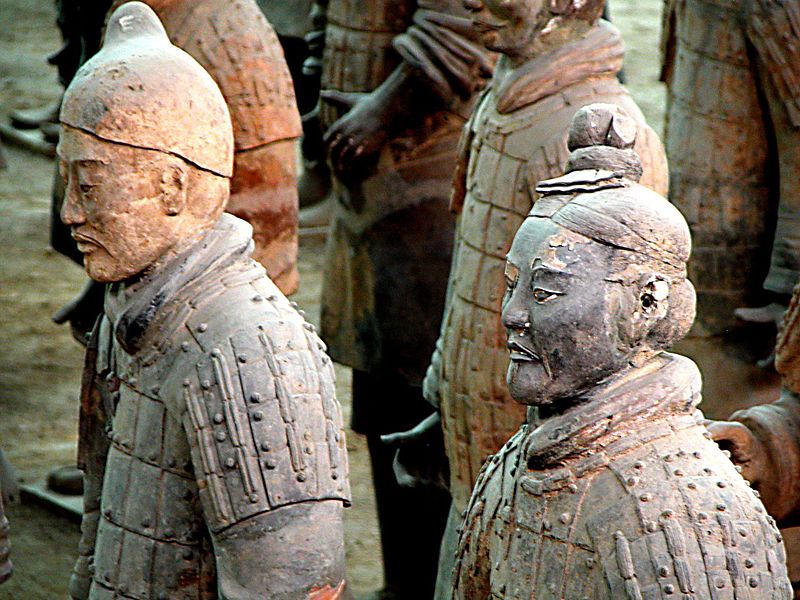
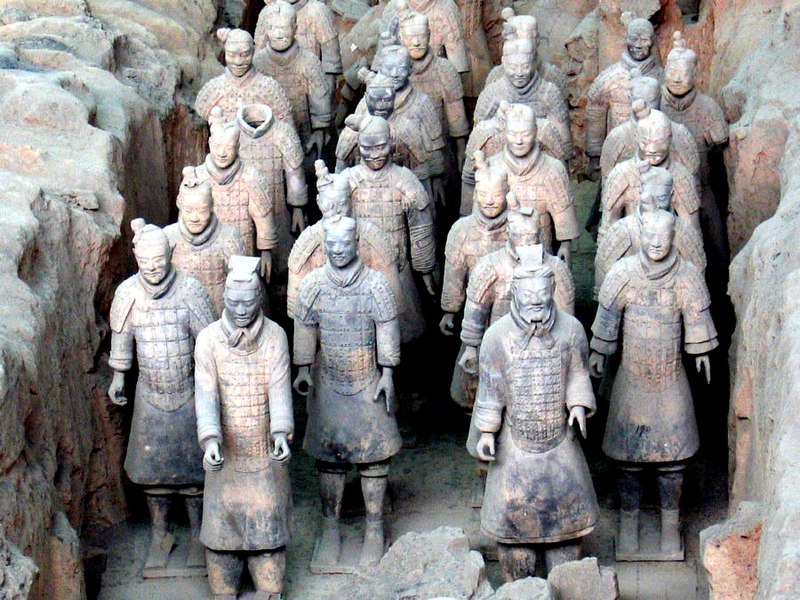
The Terracotta Army or the "Terracotta Warriors and Horses" is a collection of terracotta sculptures depicting the armies of Qin Shi Huang, the first Emperor of China. It is a form of funerary art buried with the emperor in 210–209 BCE and whose purpose was to protect the emperor in his afterlife.
The figures, dating from approximately the late third century BCE, were discovered in 1974 by local farmers in Lintong District,Xi'an, Shaanxi province. The figures vary in height according to their roles, with the tallest being the generals. The figures include warriors, chariots and horses. Estimates from 2007 were that the three pits containing the Terracotta Army held more than 8,000 soldiers, 130 chariots with 520 horses and 150 cavalry horses, the majority of which remained buried in the pits nearby Qin Shi Huang's mausoleum.[2] Other terracotta non-military figures were found in other pits, including officials, acrobats, strongmen and musicians.
The Terracotta Army was discovered on 29 March 1974 to the east of Xi'an in Shaanxi province by farmers digging a water well approximately 1.6 kilometres (0.99 mi) east of the Qin Emperor's tomb mound at Mount Li (Lishan), a region riddled with underground springs and watercourses. For centuries, occasional reports mentioned pieces of terracotta figures and fragments of the Qin necropolis – roofing tiles, bricks and chunks of masonry.[6] This discovery prompted Chinese archaeologists to investigate, revealing the largest pottery figurine group ever found in China
Since 2006, an international team of researchers at the UCL Institute of Archaeology have been using analytical chemistry techniques to uncover more details about the production techniques employed in the creation of the Terracotta Army. Using X-ray fluorescence spectrometry of 40,000 bronze arrowheads bundled in groups of 100, the researchers reported that the arrowheads within a single bundle formed a relatively tight cluster that was different from other bundles. In addition, the presence or absence of metal impurities was consistent within bundles. Based on the arrows’ chemical compositions, the researchers concluded that a cellular manufacturing system similar to the one used in a modern Toyota factory, as opposed to a continuous assembly line in the early days of automobile industry, was employed.
Grinding and polishing marks visible under a scanning electron microscope provide evidence for the earliest industrial use of lathes for polishing. Documentary video
The Baigong Pipes are a series of pipe-like features found on and near Mount Baigong, about 40 km southwest of the city of Delingha, in the Haixi Mongol and Tibetan Autonomous Prefecture, Qinghai Province, China.Some of the Baigong Pipes are reported to be associated with three caves in Mount Baigong. These caves are reported to occur within the front face of Mount Baigong. The mouths of the two smaller caves have collapsed. Only the largest cave, which is 6 meters (18 feet) high, can be entered. The vague resemblance of the top of Mount Baigong to a pyramid has been the focus of much fringe speculation.Two Baigong Pipes have been reported from the largest cave. One of these is described as being 40 cm (16 in) in diameter and preserved as a reddish-brown "half-pipe". Within the same cave, another pipe-like feature of similar diameter was also found. "Dozens" of upright pipe-like features, about 10 to 40 cm (4 to 16 inches) in diameter, were also found protruding from Mount Baigong above the largest cave.
Additional Baigong Pipes were found on shore and within Toson Lake, which lies 80 meters (260 feet) from the mouth of the largest cave. On the beach of Lake Toson, about 40 meters (130 feet) from the mouth of the largest cave, apparently flat-lying, hollow, pipe-like features were found. These reddish-brown pipe-like features range in diameter from 2 to 4.5 cm (0.8 to 1.8 inch) and have an east-west orientation. Another group of pipe-like features, presumably vertical, either protrude from or lie just below the surface of the lake.
Associated with these pipe-like features are "rusty scraps" and "strangely shaped stones". Analysis of the "rusty scraps" by Liu Shaolin at a "local smeltery" reportedly found that they consist of 30 percent ferric oxide and large amounts of silicon dioxide and calcium oxide. Because any metallurgical analysis reports the composition of a material analyzed, not in terms of the actual minerals comprising it, but only in terms of percentages of the oxides of the specific elements present, the calcium present in the "pipes" could have been in the form of calcite, a mineral that naturally forms concretions.
According to news stories, the pipes were first discovered by a group of scientists from the United States who were seeking dinosaur fossils. The scientists are said to have reported the pipes to local authorities in Delingha. However, the pipes did not attract attention until a report, possibly one of six made by Ye Zhou, appeared in the "Henan Dahe Bao" in June 2002. Quin Jianwen, a local official, discussed the pipe-like features with journalists of the Xinhua News Agency on June 16, 2002. The local government now promotes the pipe-like features as a tourist attraction, with road signs and tourist guides.According to an 2003 article in the Xinmin Weekly, Chinese scientists using atomic emission spectroscopy found the Baigong Pipes to contain organic matter of plant origin. In addition, the news article also stated that tree rings were found in sections of these rock formations and, as a result, they were judged to be fossil trees or tree roots. However, like many other aspects of the Baigong Pipes, this news report remains unsupported by either any scientific publication or other reliable primary or secondary source that discusses and documents these findings in any detail.
The state run newspaper People's Daily reported on a 2007 investigation where a research fellow from the Chinese Earthquake Administration reported they had found some of the pipes to be highly radioactive. Documentary video